


Although digital transformation amongst Legal firms has typically been comparatively slow compared to other sectors, the journey has picked up speed over the course of the last decade.
3051 Hits

Like many fixtures of our lives, Britain's pubs were heavily impacted by COVID-19, with their familiar patrons unable to come in for a post-work drink, or meet with friends at the weekend. But while it was undoubtedly a difficult period for the industry as a whole, this great British institution did as it has always done, and adapted to suit its patrons' evolving requirements.
3689 Hits

The nature of AEC projects and the high volumes of sensitive data firms generate, transfer, and store on a daily basis make them a natural target for cyber criminals. Indeed, a recent Government study found that 5% of building firms have already fallen victim to some form of cyber-crime in the just a year, but that 26% of them still did not have adequate cyber security measures in place.
2679 Hits

Now more than ever, organisations across the public and private sectors depend on seamless, secure, and high-quality communications. Even with an increasing range of channels having established themselves in recent years - including voice, email, video, and SMS - voice services remain a key part of how we communicate and collaborate.
3047 Hits

Like many longstanding institutions, Britain's world-renowned pubs are undergoing their own digital transformation journey, utilising leading-edge technologies to offer truly personalised experiences to patrons of all ages and backgrounds - from longstanding regulars visiting for their usual pint, to families looking for a meal, and young professionals working on the go. It's an exciting time for the sector as a whole, but at the same time, the drive for modernisation must not come at the expense of patrons' safety and enjoyment.
2651 Hits

With fundamental shifts in consumer behaviour, changing economic conditions, and a rapidly evolving regulatory environment, it's a challenging but exciting time for the UK's retail sector, and technology has a key role to play. In particular, advances in IT and networking solutions are empowering retailers to enhance their operational efficiency, improve the customer experience, and retain their competitive edge in an increasingly online and interconnected world.
3703 Hits

From day-to-day consumer banking to high-profile asset and wealth management, the way we all access financial services is changing in ways that would have been inconceivable just a few years ago. Online banking is now firmly established, allowing customers to manage their money securely within a few clicks - anytime, anywhere and without the need to visit a branch. A 2022 survey revealed that the quality of the online experience was a key factor in 81% of adults' choice of bank1.
2999 Hits

Effective manufacturing workflows are all about doing things more efficiently - from the simplest tasks to the most complex. While this is an ostensibly simple concept, the increasingly interconnected, global nature of modern manufacturing workflows hides a number of challenges, with even the briefest period of downtime potentially costing thousands of pounds, particularly during periods of increased consumer demand.
However, the increasing sophistication of artificial intelligence (AI) and 'smart' technologies offers a rich vein of opportunities here, allowing routine processes to be automated, where possible and appropriate. Not only will this significantly improve the overall efficiency of manufacturing processes, if successfully executed, it will lead to long-term cost savings and free staff to focus their attention on activities that will lead to fresh innovations and sustainable business growth.
With that in mind, let's consider where AI-powered automation can be of most use across manufacturing workflows…
Streamlined, proactive maintenance processes
The rollout of interconnected sensors at manufacturing sites ensures any faults can be automatically tracked, identified, and escalated to the appropriate team, ensuring the resulting downtime can be kept to the absolute minimum. Beyond ensuring a swift response to any unexpected faults, collating the data generated by these sensors and applying machine learning technologies will allow any trends to be identified and routine maintenance processes adapted accordingly, helping to resolve potential faults before they occur and ensuring costly downtime can be avoided altogether.
And, as a bonus, this will help reduce machines' energy consumption in the long term, further reducing costs and bringing manufacturers another step closer to achieving their environmental goals!

Stress-free quality control
Even the most stringent quality control processes are vulnerable to human error, but AI will not only offer a greater level of consistency, but also allow products to be examined with a level of detail that would be impossible otherwise, particularly for especially small or complex products (computer chips, for example). This way, even the most miniscule defects can be quickly identified before products reach customers, even during the busiest production cycles.
Maximum control and visibility of global supply chains
The vast range of materials utilised across manufacturing operations that must be sourced from around the world means that supply chains are inherently complex. This means there is huge potential for disruption and, in turn, downtime if any area of the supply chain fails. But just as with the machines on factory floors, AI and smart sensors allow for micro and macro views of manufacturers entire supply chains, covering everything from vehicles to individual parts. By monitoring this data and implementing effective analytics, potential disruptions can be predicted and factored into project timelines.
Developing safer factory floors
Finally, amidst all the excitement about the possibilities offered by AI, let's not forget the people who continue to drive effective manufacturing operations! The smart sensors deployed across factory floors can be complemented with wearable sensors for employees. This will ensure the risk of injury from machinery is minimised, while simultaneously supporting wider health & safety initiatives, and thus helping maintain a safer working environment. For example, in environments where employees may be required to lift heavy objects, the data generated by the wearable sensors can be used to avoid injuries by ensuring correct procedures are followed when doing so.
This is all just scratching the surface of what AI-powered automation can potentially offer manufacturers. Leaders across the industry are already exploring the full potential of these technologies, with the support of trusted technology partners, so new opportunities and innovations are sure to keep revealing themselves in the months and years ahead. As we're already seeing in our own ongoing work with manufacturers across the UK, the rise of AI shows no signs of slowing down, so don't hesitate to contact us if you'd like to discuss how it can transform your own operations. It's an exciting time for the entire sector, and we look forward to exploring it with you!
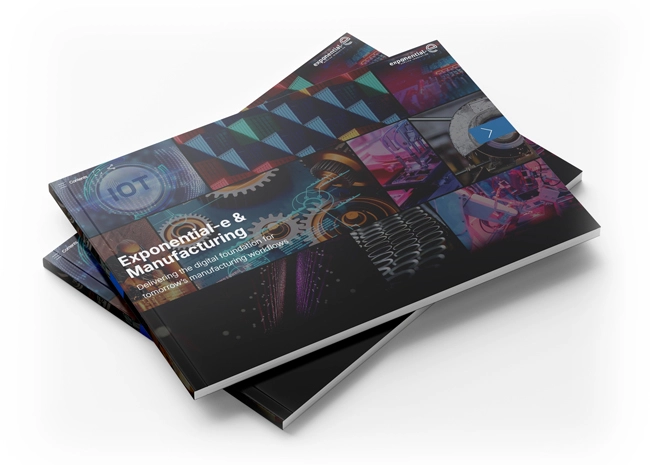
View our Manufacturing brochure
Delivering the digital foundation for tomorrow's manufacturing workflows.
Discover our full portfolio of digital innovations for Manufacturing, and how we are working with leaders across the sector to support the ongoing convergence of IT and OT, the deployment of 'smart' technologies, and the implementation of tomorrow's connected workflows.
2437 Hits

The retail landscape has fundamentally changed in recent years, partly driven by the necessities of COVID lockdowns, and partly by ongoing shifts in customer preferences and behaviour. As we have previously explored on this blog, the familiar high street shopping experience is increasingly converging with online and click-and-collect shopping, offering a new breed of data-driven shopping experience.
2057 Hits

"When it comes to digital transformation, the personal touch is often what takes projects from 'good' to 'exceptional'. Plenty of companies can deliver technology, but it's the relationships that really drive innovation in long term."
Philip Button, Regional Business Manager – Enterprise
1757 Hits

On the 18th March 2024, the Information Commissioner's Office issued its updated guidance around the issuing of fines when organisations have been found liable for the integrity of their customers' or end users' data being compromised. It is already well-established now that failure to ensure critical data remains secure will result in costly fines, as we have seen repeatedly in multiple high-profile cases over the years.
2522 Hits

To Test or Not to Test? - When it comes to IT disaster recovery and remediation processes, regular testing is not a 'nice to have' - it's absolutely essential!
This isn't hyperbole on my part. You just have to look at the news on any given day. We've all heard the horror stories of organisations in both the public and private sectors experiencing prolonged downtime during disasters due to inadequate preparation, lack of testing, and the unsuitability of their legacy remediation processes and systems.
2349 Hits

In October 2023, the British Library suffered "one of the worst cyber incidents in British history," as described by Ciaran Martin, ex-CEO of the National Cyber Security Centre (NCSC).
The notorious Rhysida ransomware gang broke into one of the world's greatest research libraries, encrypting or destroying much of its data, and exfiltrating 600 GB of files, including personal information of British Library staff and users.
78949 Hits

The international hotel chain Omni Hotels & Resorts has confirmed that a cyberattack last month saw it shut down its systems, with hackers stealing personal information about its customers.
In the aftermath of the attack, hotel guests reported that they had been forced to check in on paper, that room keys didn't work, and all phone systems and Wi-Fi were offline.
89775 Hits

Although the sector as a whole has traditionally been comparatively wary of the ever-increasing pace of technology, legal services are increasingly data driven, with an abundance of AI-related discussion emerging within legal technology circles. The core Document Management Systems (DMS) and Practice Management Systems (PMS) remain the centre of focus for how and where to deploy a variety of rapidly maturing SaaS platforms, or dedicated, highly customised suites.
2294 Hits

Security agencies in the United States have issued a new warning about the Black Basta ransomware group, in the wake of a high-profile attack against the healthcare giant Ascension.
117569 Hits

We make payments, large and small, every day of our lives. From paying our bills and making payments to friends online, to the large-scale bank transfers that help business flow. Money changes hands through a wider range of channels and platforms than ever before, to the extent the days of cash-in-hand being the default payment model are a fading memory for many of us. The convenience and flexibility can't be disputed, but as with any emerging technology, the new flows of data must be given careful consideration, ensuring businesses and customers alike can rest assured that their money will remain secure throughout every stage of every transaction.
1787 Hits

Digital transformation continues to pick up pace across the financial sector. However, in spite of the potential benefits on offer, many insurance firms continue to lag behind their peers in terms of their overall digital maturity.
1905 Hits

Organisations' demands of their IT infrastructure continue to evolve at an unprecedented rate, with the drive for growth and innovation needing to be balanced against the need to maintain cost control, visibility, and - crucially, cyber security. Numerous solutions have emerged in response to these challenges, but one of the most pivotal questions organisations must answer is whether to host their critical data and applications on-site, or in the Cloud.
Let's explore the respective advantages and disadvantages of both approaches, and then consider whether the increasing sophistication of modern workloads demand a new approach...
1826 Hits

When it comes to insurance and financial services, the ability to offer clients peace of mind is the key to ensuring the sector's continued longevity. Cyberattacks are evolving in frequency and sophistication, with criminals selecting progressively more ambitious targets, and even minor IT outages, whether they're caused by human error or 'acts of God', will have a serious effect on firms' operations, negatively affecting both profitability and brand reputation. With this in mind, firms must reconsider the way they approach operational resilience, particularly regarding the way access rights for critical systems and data are managed.
2258 Hits

© 2026 Exponential-e Ltd. Reg. No. 04499567, Reg. Address:100 Leman Street, London E1 8EU