


The way organisations design, deploy, manage, and scale their IT infrastructure has changed in ways that would have been inconceivable just ten years ago.
2387 Hits

2024 looks set to be the highest-grossing year yet for ransomware gangs, due - in no small part - to emboldened cybercriminals causing costly disruption at larger companies.
The so-called 'big-game hunting' cyberattacks which target larger, higher-value organisations have contributed to US $459.8 million paid to cybercriminals in the six months of 2024, according to a report by the cryptocurrency research firm Chainalysis.
Although the rise in money criminals have generated through ransomware has risen by what may appear to be a small percentage amount (approximately 2% from US $449.1 million to US $459.8 million), this is in spite of disruption caused to ransomware-as-a-service operations such as LockBit and ALPHV/BlackCat by law enforcement agencies.
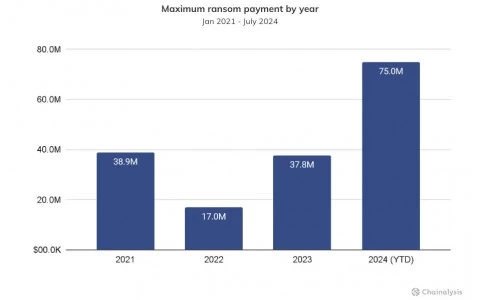
The figures for the first half of 2024 include the US $75 million reportedly paid to the Dark Angels ransomware gang by an undisclosed Fortune 50 company, in what was believed to be the largest ever single ransom payment made since records began.
The ballooning size of maximum ransom payments represents a 96% year-on-year growth from 2023, and a 335% increase from the maximum payment made in 2022.
Chainalysis's research reveals that the median ransom payment made in response to the most severe ransomware has rocketed from just under US $200,000 in early 2023 to US $1.5 million by mid-June 2024.
The researchers believe that this 7.9x increase in the typical size of ransom payment (a nearly 1200x rise since the start of 2021) suggests that larger businesses and critical infrastructure providers considered more likely to agree to make higher payments due to their greater access to funds and the more significant impact of downtime.
Against this backdrop, the study claims that ransomware victims are giving in to extortion demands less often. As it explains:
Posts to ransomware leak sites as a measure of ransomware incidents have increased YoY by 10%, something we would expect to see if more victims were being compromised. However, total ransomware payment events as measured on-chain have declined YoY by 27.29%. Reading these two trends in tandem suggests that while attacks might be up so far this year, payment rates are down YoY. This is a positive sign for the ecosystem signalling that perhaps victims are better prepared, negating the need to pay.
In short, ensuring that your organisation had prepared to respond to a ransomware attack is essential.
Many organisations underestimate the importance of having a robust incident response plan. But knowing how to respond, especially in those critical first 48 hours after a cyber attack, can be critical.
Do you worry your company won't know how to recover after a cyber attack? Has your business just been hit by ransomware and you're wondering what to do?
There's still hope.
Don't make the mistake of believing that your organisation will never be targeted. The right approach is to take proactive measures in advance - as it's not a case of whether your business will suffer the likes of a ransomware attack but when.
Make sure to read Exponential-e's step-by-step guide on ransomware remediation.
92998 Hits

As organisations generate, manage, and store more data than ever before, it's not hard to see why the ongoing march of Cloud transformation shows no signs of slowing down. But for all the Cloud's advantages in terms of flexibility, scalability, and cost control, it is not suitable for every application.
2791 Hits

The UK government has proposed extending its ban on ransomware payments to cover the entire public sector in an attempt to deter cybercriminal attacks and protect taxpayers.
63643 Hits

The level of legacy debt varies widely across the NHS and a recent report from the Department of Science Technology and Innovation (DSIT) has revealed that legacy technology can range from as little as 10 to as much as 60-70%. This reliance on outdated systems presents a significant cyber security challenge, heightened by the fact that 15% of surveyed organisations could not estimate the size of their legacy estate. The report also highlights that these systems are high-risk, prone to security vulnerabilities, lack support, and subject to operational failures.
1813 Hits

A UK firm has been hit by a £3.07 million fine after being hit by a ransomware attack that exposed sensitive data related to almost 80,000 people, and disrupted NHS services.
82869 Hits

The security of enterprise networks is a critical priority for all organisations across the public and private sectors, as they are forced to contend with an increasingly turbulent cyber threat landscape. As a result, network teams increasingly find their roles overlap with their organisations' cyber security strategies, with numerous siloed elements now converging.
2222 Hits

For many Chief Information Security Officers (CISOs), the first challenge isn't stopping a breach, it's knowing where the breach could even happen. Healthcare IT estates are some of the most complex and fragmented in the public sector.
1559 Hits

Across the Hospitality & Leisure sector, from pubs to five-star hotels - guests' expectations have evolved in ways that would have been impossible to imagine just a decade ago.
1495 Hits

We've been hearing about the impending demise of the high street for years now, ever since online shopping and click-and-collect established themselves as part of our day-to-day lives. And yet, while brick-and-mortar retail has certainly been through a great many challenges and upheavals, it doesn't show any sign of going away quite yet. Rather than simply expecting customers to be content with previous generations' shopping experiences, the sector has demonstrated considerable ingenuity by taking full advantage of emerging technologies to deliver the kind of personalisation that would previously have been the sole preserve of online platforms.
1982 Hits

The recently released NHS 10 Year Health Plan is part of the Government's mission to build a health service fit for the future. Setting out how the government will reinvent the NHS through three radical shifts: hospital to community, analogue to digital and sickness to prevention.
1400 Hits

Critical infrastructure organisations are once again being warned of the threat posed by malicious cybercriminals, following a ransomware attack against a state-owned energy company in Pakistan.
4059 Hits

A 30‑year‑old man has been charged with launching a cyberattack on the German subsidiary of Russia's state-owned oil giant Rosneft. The cyberattack, which happened in March 2022 in the aftermath of Russia's invasion of Ukraine, crippled the company's operations and cost millions of euros in damages.
3153 Hits

Traditionally, retailers' biggest security concern has been theft, and so CCTV systems evolved to ensure shoplifters could be identified as quickly as possible and stock shrinkage minimised, forming a foundational element of on-site infrastructure. However, as retailers expanded their operations and looked to achieve seamless communication and interoperability between sites and warehouses, the security concern grew to include data theft, and so secure, resilient connectivity became a key priority.
1130 Hits

What's happened?
Recorded Future has reports that the British Government is proposing sweeping change in its approach to ransomware attacks.
119866 Hits

Now more than ever, effective collaboration and communication are the keys to success. Throughout 2020, we saw a widespread shift in how we interact with each other, both in and out of work, and how we stay connected to our colleagues and customers. Just consider the following:
3604 Hits

Microsoft Teams has been in the ascension for some time now, rising exponentially in popularity throughout 2020, to the point it is now the default internal communications tool for many organisations, with the distributed workforce utilising it to effectively collaborate with colleagues on a day-to-day basis.
2877 Hits

Global broadcasts place incredible demands on infrastructure, which must offer the performance and resilience required to accommodate the anticipated spikes in viewership. Exponential-e has worked closely with a number of world leaders across the broadcasting and media sector, providing fully integrated solutions that ensure their connectivity is of the very highest quality, freeing their own teams to focus on the broadcast itself, safe in the knowledge that they can completely depend on their technological foundation, no matter how many viewers around the world tune in.
3008 Hits

Throughout these unprecedented times, many Resellers and Systems Integrators have been forced to furlough team members or reduce headcount, creating leaner operations in order to weather the economic downturn. But as we now approach an economic return and ramp up our trading levels, these resourcing gaps can limit the services that resellers can take to market.
3717 Hits

Maximising performance, scalability, and compliance for a leading innovator in online banking
About Tandem Money
Tandem is 'The Good Green Bank', a fully regulated digital app‐based bank founded on the idea of putting customers' needs first whilst helping them save more than just their money by pushing for a sustainable future. The acquisition of green lender Allium in 2020, an established green homes lender, accelerated Tandem's mission into the green space. Tandem offers savings, mortgages, and loans to help customers green their properties, and eventually their lives.
Challenges
The key driver behind Tandem's ongoing digital transformation was earning a full banking license in 2018 - something that had been a core focus of their infrastructure's evolution. This meant their infrastructure would need to fulfil all legal and compliance obligations around the handling of financial data, and also demonstrate the highest standard of operational resilience.
At the time, Tandem's IT and telephony infrastructure was hosted at various separate data centres, while their banking application was hosted on AWS services, and a separate site set aside for workplace recovery. Although multiple sites were involved here, the whole network depended on the London office, creating a single point of failure.
After a comprehensive evaluation of various suppliers, Tandem engaged with Exponential‐e to ensure these critical elements could be securely interconnected in order to maximise performance and scalability and ensure all requirements for full bank status were achieved. Exponential‐e's deep experience in the financial sector was critical here, providing Tandem with complete confidence that the partnership would provide a positive contribution to their journey.
Solution
The networking solution delivered by Exponential‐e interconnected all Tandem sites via a high-performance WAN - a fully managed low‐latency solution that ensured consistent performance across all sites. This was implemented by a dedicated Exponential‐e account team, who project managed every stage of the deployment to ensure there would be no service disruption and that Tandem's long-term goals remained the primary focus throughout the deployment and beyond.
Critically, this fulfilled all compliance requirements regarding the handling and storage of financial data, while ensuring Tandem's teams would have the right tools at their fingertips at all times. To ensure a disruption free migration process, secure connections were created between Exponential-e's self‐owned network and Tandem's AWS services, allowing for a successful consolidation of the different elements of their infrastructure, and providing IT teams with a higher level of control and visibility.
As the partnership between Tandem and Exponential‐e evolved, a combination of a Virtual Private Network (VPN) and Office 365 was established as the ideal combination of solutions to further optimise Tandem's overall efficiency and enable effortless collaboration between their various teams, regardless of where they were located, with security policies applied automatically and role‐based segregation opening up a wide range of opportunities for remote working.
Throughout 2020, when the COVID‐19 pandemic forced organisations worldwide to rapidly transition to a remote workforce, the inherent flexibility and scalability of Tandem's infrastructure and a robust business continuity plan showed its true worth, as the entire workforce were able to begin working remotely with minimal disruption to day‐to‐day operations, and no compromise in terms of security and compliance. This option had already been utilised on an ad‐hoc basis by Tandem's engineers, but a scenario where it would need to be utilised on a company‐wide basis had been considered and factored into the business continuity plan, with tests taking place to ensure such measures would be viable, should they ever be needed.
In this way, Tandem has demonstrated how the right infrastructure, with the support of the right technology partner, provides organisations in even the most challenging sectors with the agility to pivot in response to unexpected, large‐scale shifts in the digital landscape. Tandem's long‐term digital transformation continues, with plans in place to bring its core banking suite in house and into the Cloud, for a further layer of control and flexibility.
Solution benefits
- High‐performance VPN connectivity across multiple sites, with secure connections to the core banking suite provider.
- Full compliance with all applicable regulations regarding the handling of financial and sensitive data.
- A stress‐free transition to remote working, with zero compromise in the security of users' financial and sensitive data.
- A strong foundation for ongoing Cloud transformation and consolidation.
Exponential-e is a trusted technology partner for organisations across the Finance sector, offering innovative solutions that drive security, compliance and optimal performance at all levels.
Find out more in our Finance Brochure.

5612 Hits

© 2026 Exponential-e Ltd. Reg. No. 04499567, Reg. Address:100 Leman Street, London E1 8EU