


Working together to establish a new standard of excellence for IT service desk operations
About BDO
BDO UK provides tax, audit and assurance, advisory, and business outsourcing services to companies across the public and private sectors, with more than 9,500 employees operating out of 18 office locations across the UK.
The Challenge
In order to better support its analysts across the country, the decision was made to execute a full-scale digital transformation of the entire Virtual Contact Centre and Teams Dialling system, building on the existing investment in Microsoft Teams to establish a centralised platform through which end users could make contact via a range of channels, including voice, email, and chatbot. This would ultimately support the phasing out of legacy telephony in favour of more scalable, flexible omnichannel solutions, while providing team leaders with real-time visibility of the entire service desk operation. The quality of BDO's IT service desk improved as an outcome acknowledged by the Service Desk Institute, who awarded it a four-star rating in 2024.
Critical priorities for the project were simplifying the management of Microsoft Teams licences, which needed to be purchased on an individual basis with the incumbent solution, and streamlining and optimising the user journey wherever possible, taking full advantage of the latest innovations in AI-powered automation and analytics.
A rigorous tender process was conducted, with a key priority being the ability to design and deliver a solution within four months, avoiding any operational disruption. At the end of this process, Exponential-e were selected as the sole technology partner for the project, building on an already strong partnership with BDO, and began working closely with their contact centre and back-office teams to determine the ideal specifications for the new platform.
Based on this findings of this assessment process, Exponential-e's Teams Calling as-a-Service platform, integrated with the industry-leading Five9 Intelligent CX suite and the ServiceNow® ITSM solution, was identified as the perfect fit for BDO's requirements, providing users with the Teams functionality they had come to depend on, while also opening the door to a wide range of potential enhancements.
The Solution
The tools Exponential-e have provided have contributed towards the digital transformation journey BDO have been on. Our mutual passion for the user experience has helped us reshape our whole approach to the service desk, and we're very much looking forward to building on these successes in the years ahead.
Lee Trimmer, Head of Service Delivery, BDO
The first phase of the deployment involved managing a seamless transition for all analysts and end users by replicating their existing Teams functionality in the new platform, allowing them to start making use of it straight away. This meant the migration process was completely invisible to the 6,000 employees already using Teams.
With this foundation in place, BDO began working with their dedicated account team to identify potential opportunities for automation, the first of which involved the onboarding process for new joiners, who would automatically receive an email with the details of the Teams dial pad, with no manual intervention required. At the same time, should an end user leave the company, their account would automatically be closed and their number made available again. This pay-as-you-go model immediately resulted in tangible cost savings by ensuring BDO would only ever pay for the licences in active use.
Building on this, the Five9 platform was heavily customised to suit BDO's specific goals for its overall user journey. Key to this was the integration of the platform's chatbot with BDO's own Azure LLM and ServiceNow®, allowing it full access to an evolving knowledge library. This bespoke chatbot (dubbed ELSA!) is now able to automatically direct users to the article most likely to lead to a successful resolution. If it is unable to do so, they are automatically put through to the appropriate analyst.
ELSA's intuitive, conversational interface and broad range of insights meant the initial uptake was high, averaging more than 200 interactions per month, of which around 50% are resolved with no need for human intervention. The chatbot's capabilities have since been extended to run automated routine fixes with BDO's primary audit tool, saving service desk analysts time and offering the users faster resolutions.
As a result of these improvements, BDO have significantly reduced their service desk's dependence on traditional telephony and email, with most end users now preferring the inherent flexibility and ease of the new chat and self-service options, allowing analysts to more efficiently manage their cases.
With the implementation of Five9's workforce engagement tool, BDO are looking to automate further quality control checks to focus directly on problem areas rather than relying on dip sampling calls. Through the application of intelligent analytics, this identifies which interactions team leaders should listen to in order to support their analysts, identify gaps in the user experience, and act on new opportunities for improvement as they emerge. When combined with the technical data collected by ServiceNow®, this will provide BDO with a holistic, real-time view of its entire service desk operation.
The transformation of BDO's service desk was later recognised at the Service Desk Institute's 2025 awards ceremony, where it was named as 'Service Desk of the Year – Large Team'. It is also now eligible to be certified as a five-star service desk, of which there are only four in the world at the time of writing.
BDO have long led the charge for service desk excellence, and the success of this project is testament to that. When people and technology come together in this way, a seamless, interconnected user experience becomes possible across every channel, which I fully expect to become the new standard for service desk operations.
Gareth Hayes, Head of UC & CX Solutions, Exponential-e
Solution Benefits
- A seamless migration process from disparate
legacy technologies, with no disruption to day-to-day operations
- Intelligent automation of routine processes
enhances analysts' efficiency and performance, freeing them to focus on the
most complex cases
- 50% of all interactions resolved without any
need for human intervention, thanks to a bespoke chatbot and evolving knowledge
base
- Automated onboarding and offboarding of employees and sustainable cost savings through pay-as-you-go pricing
1336 Hits

An AI-powered Approach to Delivering Local Government Services
The UK's local councils are challenged on a growing range of fronts. Budgets and resources are shrinking, but citizens' expectations around the quality and availability of the full range critical services must still be fulfilled, whether this involves making sure the bins are always collected on time, or ensuring the most vulnerable are able to access the support they need. Indeed, at the time of writing, one local council's list of services runs to seventeen pages, with over four-hundred individuals involved in their delivery.
Put simply, councils' frontline staff are being forced to do more with less, making these highly complex service environments prime candidates for intelligent automation. But, as is often the case when it comes to the deployment of agentic AI technologies - there's a lot to consider if the initial investment is to deliver the desired outcomes. Consider the following:
- 66% of councils have trouble understanding where AI can deliver the greatest value.1
- 43% of local councils saying the lack of clear use cases is a barrier to AI adoption.2
While many councils have already realised agentic AI's applications for purely transactional services (e.g. the payment of parking fines or council tax), it is clear that a deeper understanding of its potential applications is still needed.
One common misunderstanding around AI is that it is best used to replace human agents wherever possible, but this is a fatal misconception. This technology's full potential is as an enabler and enhancer of human expertise and experience, allowing frontline staff to consistently deliver their best while simultaneously ensuring their wellbeing is protected.
Consider a list of services like the one we touched on at the beginning of this article - a quite typical service wrap for local Government organisations. No human agent could sensibly be expected to be able to deliver that many services, but at the same time, hiring individual specialists for every area is not going to be practical when doing more with less is the order of the day.
Agentic AI offers a third way, automatically putting the information and resources agents need to deliver successful resolutions right at their fingertips, without requiring them to manually parse complex knowledge libraries.
AI's ability to translate high volumes of data into an actionable form in real-time is unprecedented. Critically, this does not just have to mean formal knowledge bases that Government departments maintain themselves - it can also browse relevant websites, PDFs, and other sources of information, collating their findings in agents' dashboards in response to the most specific queries, including providing practical steps towards a resolution. This not only significantly eases the pressure on frontline staff, but can also reduce the time and expense involved in training new agents or broadening the capabilities of existing ones.
AI's ability to translate high volumes of data into an actionable form in real-time is unprecedented. Critically, this does not just have to mean formal knowledge bases that Government departments maintain themselves - it can also browse relevant websites, PDFs, and other sources of information, collating their findings in agents' dashboards in response to the most specific queries, including providing practical steps towards a resolution. This not only significantly eases the pressure on frontline staff, but can also reduce the time and expense involved in training new agents or broadening the capabilities of existing ones.
At Exponential-e, we're already working closely with a number of Government organisations (and numerous others from across the public and enterprise sectors) to bring these concepts to life and establish a clear standard of best practice around where and how agentic AI is implemented. These "cyber advisors", as they are increasingly called, are transforming the way local Government's contact centre environments operate, ensuring citizens enjoy the fastest possible resolutions, while simultaneously freeing up time and resources that can be reinvested in other public services.
Of course, this must all begin with the right foundation - specifically, a thorough assessment of an organisation's current customer journey, which will reveal where the implementation of agentic AI will bring the greatest possible benefits, and how the necessary changes can best be executed. Contact us today to arrange your own consultation and take the first step towards building your own team of world-class cyber advisors.
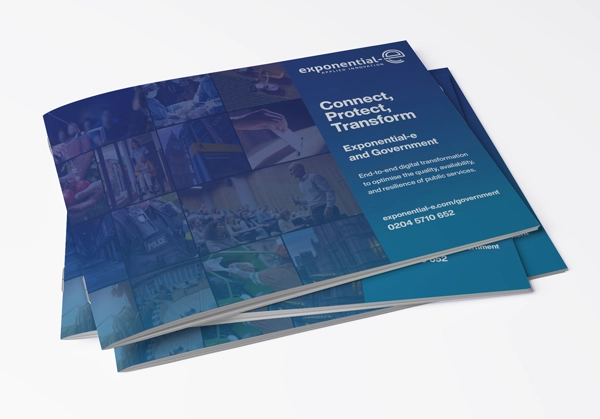
A secure digital foundation for better citizen outcomes, operational resilience, and long-term value.
Public sector organisations are under pressure to deliver more with less while meeting rising expectations for secure, always-available services. This guide shows how an integrated approach to connectivity, cloud, cyber security, and communications creates the resilience, scalability, and compliance government demands – turning digital strategy into real community impact.
651 Hits

Across the hospitality sector, the new breed of interconnected guest experience means that expectations are at an all-time high. New opportunities to deliver truly personalised experiences that help brands establish their place in the public consciousness continue to reveal themselves, but the resulting pace of digital transformation means that these inevitably come with new challenges. With multiple channels now typically involved in each guest's journey - from booking to arrival, checkout, and beyond - many hospitality professionals are finding themselves short-staffed, unable to manage the growing complexity of their day-to-day operations.
1486 Hits

Our universities are currently challenged on multiple fronts. Most obviously fees have been frozen for some years now while salaries continue to rise, leading to extreme financial pressure. At the same time, competition from international universities is fierce, particularly when it comes to attracting students from abroad. As such, it is essential that our universities are not only able to attract new students, but also retain them throughout the duration of their studies, and potentially on to post-grad work.
771 Hits

For a number of years now, the evolution of the Retail sector has typically been positioned as brick-and-mortar shops - including many longstanding fixtures of UK highstreets - fighting a losing battle against online retailers, such as the seemingly monolithic Amazon. However, the reality of the situation is not quite so clear cut…
3110 Hits

The Finance sector has always been one of the most dynamic, rapidly evolving industries, and this shows no signs of changing any time soon. But while shifts in the landscape may well open new opportunities, they will also come with new challenges, and it is the organisations who are ready and able to face these head-on who will continue to thrive in the years ahead.
3220 Hits

Secure Access Service Edge (SASE) is rapidly establishing itself as the solution of choice for the next generation of enterprise networks, where optimal control, visibility, and scalability are essential. In the first quarter of 2024 alone, the SASE market experienced a 23% surge, as more and more organisations began taking advantage of its capabilities.
4573 Hits

In the space of just a few short years, Artificial Intelligence (AI) has gone from being a somewhat niche field, to front and centre in the public consciousness. With the rise of ChatGPT and similar platforms, there is much speculation about where this technology is heading, and what its impact will be on our personal and professional lives. Indeed, organisations across numerous sectors are already exploring the different ways it can be utilised to reduce costs, optimise efficiency, and improve service quality.
3758 Hits

Selecting the right storage architecture is essential for organisations that are leveraging Artificial Intelligence (AI), Machine Learning (ML), Big Data and IoT analytics. For example, AI applications that involve scientific and medical research create and interact with numerous large files, and therefore need a storage system that can scale to a petabyte level, with zero restrictions. Similarly, ML applications and Big Data projects require a scalable, cost-effective storage solution to accommodate the high volumes of data that will be produced. This raises the question of which storage solution enterprises should use to underpin their overall analytics strategies.
4477 Hits

The healthcare sector generates higher volumes of patient data on a daily basis than ever before - all of which conceals a rich vein of opportunities to optimise efficiency and enhance patient care. The demand for more efficient diagnosis and more effective management of data has naturally led to the rise of digital pathology and - in turn - the Picture Archiving and Communication Systems (PACS) that underpin these initiatives.
4461 Hits

The past decade has been a challenging one for the Retail sector, to say the least. Much has already been written about the impact of online shopping and streaming services on the high street, and the rise of COVID-19 and recent supply chain disruptions have only compounded the challenges facing even the most established brick-and-mortar retailers.
2784 Hits

When it comes to building brand loyalty, customers increasingly expect the retailers they shop from - whether that's online, in person, or via click-and-collect - to demonstrate tangible efforts to operate in an ethical, sustainable, and environmentally friendly manner in everything they do.
2923 Hits

For many years, retailers' CCTV systems and IT infrastructure have operated in relative isolation, competing for space and resources whilst never utilising the full potential of their combined power. The good news is that next-generation IT infrastructure is increasingly bridging this gap, in order to reduce costs, simplify infrastructure, and allow retailers to access a range of actionable data streams through AI and analytics.
3882 Hits

When you think of a truly world-class shopping experience, what are the key elements that immediately spring to mind? For most of us, it's the personal touches… We're greeted by name by a familiar shopping assistant, who's already familiar with our preferences and purchasing habit. They'll guide us through the entire experience, offering advice and special offers throughout. Regardless of the actual quality of the product or service, it's these touches that will establish it as high-end in the minds of shoppers and encourage them to cultivate relationships with specific brands. It's a model that the world's most renowned retailers have cultivated for years.
4225 Hits

Manufacturing workflows are evolving at an unprecedented rate, and the trend shows no signs of slowing down. The increasing effectiveness and affordability of 'smart' technologies and the Internet of Things means IT and OT are increasingly interconnected, with increasing volumes of data flowing between sites and devices on an ongoing basis.
3008 Hits

Like many fixtures of our lives, Britain's pubs were heavily impacted by COVID-19, with their familiar patrons unable to come in for a post-work drink, or meet with friends at the weekend. But while it was undoubtedly a difficult period for the industry as a whole, this great British institution did as it has always done, and adapted to suit its patrons' evolving requirements.
3898 Hits

Like many longstanding institutions, Britain's world-renowned pubs are undergoing their own digital transformation journey, utilising leading-edge technologies to offer truly personalised experiences to patrons of all ages and backgrounds - from longstanding regulars visiting for their usual pint, to families looking for a meal, and young professionals working on the go. It's an exciting time for the sector as a whole, but at the same time, the drive for modernisation must not come at the expense of patrons' safety and enjoyment.
2791 Hits

Effective manufacturing workflows are all about doing things more efficiently - from the simplest tasks to the most complex. While this is an ostensibly simple concept, the increasingly interconnected, global nature of modern manufacturing workflows hides a number of challenges, with even the briefest period of downtime potentially costing thousands of pounds, particularly during periods of increased consumer demand.
However, the increasing sophistication of artificial intelligence (AI) and 'smart' technologies offers a rich vein of opportunities here, allowing routine processes to be automated, where possible and appropriate. Not only will this significantly improve the overall efficiency of manufacturing processes, if successfully executed, it will lead to long-term cost savings and free staff to focus their attention on activities that will lead to fresh innovations and sustainable business growth.
With that in mind, let's consider where AI-powered automation can be of most use across manufacturing workflows…
Streamlined, proactive maintenance processes
The rollout of interconnected sensors at manufacturing sites ensures any faults can be automatically tracked, identified, and escalated to the appropriate team, ensuring the resulting downtime can be kept to the absolute minimum. Beyond ensuring a swift response to any unexpected faults, collating the data generated by these sensors and applying machine learning technologies will allow any trends to be identified and routine maintenance processes adapted accordingly, helping to resolve potential faults before they occur and ensuring costly downtime can be avoided altogether.
And, as a bonus, this will help reduce machines' energy consumption in the long term, further reducing costs and bringing manufacturers another step closer to achieving their environmental goals!

Stress-free quality control
Even the most stringent quality control processes are vulnerable to human error, but AI will not only offer a greater level of consistency, but also allow products to be examined with a level of detail that would be impossible otherwise, particularly for especially small or complex products (computer chips, for example). This way, even the most miniscule defects can be quickly identified before products reach customers, even during the busiest production cycles.
Maximum control and visibility of global supply chains
The vast range of materials utilised across manufacturing operations that must be sourced from around the world means that supply chains are inherently complex. This means there is huge potential for disruption and, in turn, downtime if any area of the supply chain fails. But just as with the machines on factory floors, AI and smart sensors allow for micro and macro views of manufacturers entire supply chains, covering everything from vehicles to individual parts. By monitoring this data and implementing effective analytics, potential disruptions can be predicted and factored into project timelines.
Developing safer factory floors
Finally, amidst all the excitement about the possibilities offered by AI, let's not forget the people who continue to drive effective manufacturing operations! The smart sensors deployed across factory floors can be complemented with wearable sensors for employees. This will ensure the risk of injury from machinery is minimised, while simultaneously supporting wider health & safety initiatives, and thus helping maintain a safer working environment. For example, in environments where employees may be required to lift heavy objects, the data generated by the wearable sensors can be used to avoid injuries by ensuring correct procedures are followed when doing so.
This is all just scratching the surface of what AI-powered automation can potentially offer manufacturers. Leaders across the industry are already exploring the full potential of these technologies, with the support of trusted technology partners, so new opportunities and innovations are sure to keep revealing themselves in the months and years ahead. As we're already seeing in our own ongoing work with manufacturers across the UK, the rise of AI shows no signs of slowing down, so don't hesitate to contact us if you'd like to discuss how it can transform your own operations. It's an exciting time for the entire sector, and we look forward to exploring it with you!
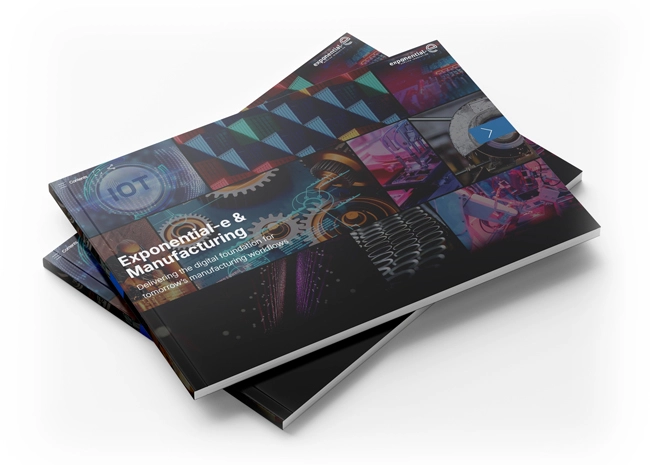
View our Manufacturing brochure
Delivering the digital foundation for tomorrow's manufacturing workflows.
Discover our full portfolio of digital innovations for Manufacturing, and how we are working with leaders across the sector to support the ongoing convergence of IT and OT, the deployment of 'smart' technologies, and the implementation of tomorrow's connected workflows.
2553 Hits

Customer service is in the middle of a deeply transformative period. Regular readers of this blog will already be familiar with the role AI has to play in this journey, and the way technologies like machine learning and Natural Language Processing (NLP) are transforming the customer experience.
2189 Hits

On the morning of 12th September 2024, the UK Health Secretary, Wes Streeting, pinpointed three 'big shifts' that would be required to transform the NHS:
- From hospital to community care
- From analogue to digital
- From treating sickness to preventing it
3248 Hits

© 2026 Exponential-e Ltd. Reg. No. 04499567, Reg. Address:100 Leman Street, London E1 8EU