


The question every leader should ask this week:
"If my Cloud provider went down tomorrow, would my business stay online and remain trading?"
If the answer isn't a confident "yes," it's time to reconsider your business continuity strategy...
Recent outages from AWS (20-10-25) and Azure (30-10-25) left global organisations offline for hours. Critical applications went dark, disrupting entire operations, along with the associated revenue streams and the cost of a workforce unable to work!
2165 Hits

In today's interconnected society, our data is a fundamental part of our personal and professional lives, informing everything from the way we communicate and collaborate with our colleagues to the way we do our weekly shop. Seamless, secure flows of data have transformed the way we access many critical services and helped bring a rich vein of new innovations to market, but as with any period of intensive technological evolution, these benefits have come at a price…
In a highly unpredictable geopolitical landscape, the growing volumes of data created, stored, and transferred by public sector and enterprise organisations present an extremely attractive target for bad actors, as does corporations' intellectual property and citizens' personal data. It's unsurprising that organisations across the public and private sectors are treating the continued integrity of their data as a critical priority – not only to avoid the financial and reputational consequences of a breach, but also to provide customers and prospects with assurance that their critical data will always be protected, both at rest and in transit.
Data sovereignty is a key part of this journey, by which we mean – in the broadest sense – guarantees over the geographical locations in which data may be stored. Most technology providers will already have such guarantees in place, typically involving the location of their hosting environments. However, with the now near-ubiquity of Cloud platforms and the growing complexity of security and compliance, the nature of true data sovereignty is no longer so clear.
With this in mind, consider the following questions when evaluating Cloud providers…
Is your Cloud provider fully incorporated in your desired location? While they may maintain hosting environments there, can they say the same for the Cloud platforms you will be utilising, particularly if they are operating as part of a larger umbrella company? If not, you cannot guarantee that your data will remain within the country when in transit, which may lead to compliance and security issues
Will they maintain full jurisdictional control of all data? Related to the above point, with several governments having now implemented regulations that grant them access to data stored in Cloud platforms (e.g. the US Cloud Act), providers must be able to guarantee that customer data will never be subject to such overreach. This is especially critical for any sort of public sector data, particularly Government and defence.
Can they specify which personnel have access to their Cloud platforms? Again, all engineers who will be maintaining the Cloud platform and acting on behalf of customers must be based in their sovereign nation, with the appropriate clearances and certifications in place.
Does their data sovereignty extend to their disaster recovery and business continuity practices? The sovereignty of data centres must extend to back-up environments, which must also be located in the designated geographical region, with air gapping, data encryption, and zero-trust security measures utilised as appropriate, and all of this subject to annual audit.
Will they maintain full jurisdictional control of all data? Related to the above point, with several governments having now implemented regulations that grant them access to data stored in Cloud platforms (e.g. the US Cloud Act), providers must be able to guarantee that customer data will never be subject to such overreach. This is especially critical for any sort of public sector data, particularly Government and defence.
Can they specify which personnel have access to their Cloud platforms? Again, all engineers who will be maintaining the Cloud platform and acting on behalf of customers must be based in their sovereign nation, with the appropriate clearances and certifications in place.
Does their data sovereignty extend to their disaster recovery and business continuity practices? The sovereignty of data centres must extend to back-up environments, which must also be located in the designated geographical region, with air gapping, data encryption, and zero-trust security measures utilised as appropriate, and all of this subject to annual audit.
This is why Exponential-e has continued to develop our ability to guarantee true data sovereignty, in direct response to the evolving digital and geopolitical landscapes. To this end, we were recently certified as a VMware Sovereign Partner, reflecting our ability to provide complete assurance around the sovereignty and control of digital assets. The are multiple dimensions to this, including our hosting facilities, support, management, regional jurisdictions, security clearances, and ability to deliver complementary services, such as Bring Your own Key (BYoK) and both shared and dedicated Cloud environments. As a proudly UK-based company for more than twenty years, our full range of solutions is designed with true sovereignty inherent in the design – something we continue to develop in response to the latest regulations, geopolitical shifts, and security challenges.
If you are in any way concerned about the sovereignty of your data and your key platforms, do not hesitate to reach out to our team, who will guide you through these challenges, ensuring you can continue your Cloud journey with complete peace of mind.
803 Hits

Across both the public and private sectors, organisations have been accelerating their Cloud transformation plans for more than a decade now. What began as a rather niche technology has now become an intrinsic part of enterprise infrastructure, to the extent virtually every organisation utilises Cloud platforms of some description. And that's great! As the past seventeen years have demonstrated, there are numerous advantages to Cloud adoption, from the inherent scalability and agility to the potential for enhanced security across the most highly distributed infrastructure.
915 Hits

A new approach to managing and hosting critical data in support of the UK's Defence and national security
In a comparatively short space of time, the integrity of the UK's data has become a top priority for our Defence sector, with bad actors mounting an increasingly sophisticated range of attacks to disrupt critical services, potentially putting lives at risk and compromising our national security.
1187 Hits

The Challenge
The customer embarked on a strategic digital transformation by migrating critical business systems from fragmented on-premises infrastructure to Microsoft Azure. This transition would not only modernise their IT operations across five European countries but also deliver significant financial savings and operational efficiencies through smart licensing and resource planning.
Throughout the transformation process, the customer faced challenges with maintaining disparate legacy systems across multiple locations, which led to inefficiencies, high operational costs, and limited scalability. They needed a unified, secure, and scalable Cloud platform to support business growth and enable remote working capabilities.
The Solution
The customer engaged Exponential-e to deliver a phased Azure migration strategy, including:
- Professional Services for planning, governance, and execution
- Managed Services for ongoing support and optimization
- CSP services for Azure resource billing
The migration was executed in stages across five European and UK locations, using a combination of rehosting and rebuilding application servers. Microsoft technologies such as Azure Migrate, Azure Backup, Azure Site Recovery, and Azure Virtual Desktop were key enablers.
The project was delivered collaboratively between the customer's internal IT team and Exponential-e's consultants, ensuring alignment with business goals and knowledge transfer. The approach followed Microsoft's Cloud Adoption Framework, ensuring best practices in governance, security, and operational readiness. The successful implementation positioned the customer for future innovation and growth on a modern Cloud foundation.
Solution Benefits
- Migration of 38 Virtual Machines to Azure.
- Implementation of 2 x 100TB GRS Reserved Backup Instances.
- Licensing of 48 x SQL Server Standard (two Core Packs).
- Licensing of 22 x Windows Server 2022 Datacentre (eight Core Packs).
- Overall savings of £100,000 on Azure spend through strategic use of Microsoft Savings Plans and Reserved Instances.
- Improved governance, scalability, and remote working capabilities.
- Consolidation of infrastructure across five countries into a single Cloud platform .
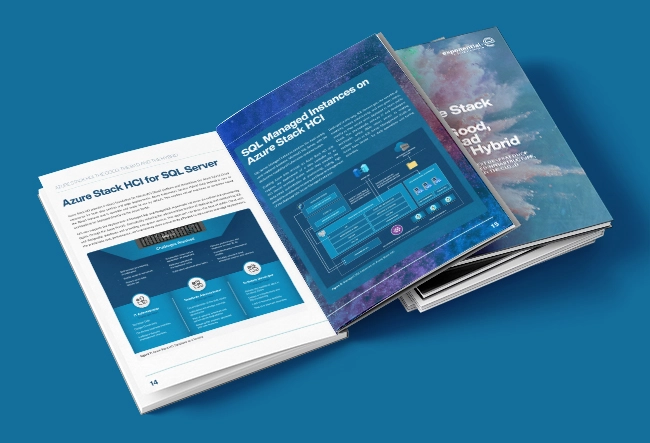
Azure Stack HCI
The Good, The Bad & The Hybrid
In this exclusive whitepaper from Exponential-e's Cloud transformation specialist, James Pearce, discover how the next generation of hyperconverged infrastructure is transforming the way organisations design, deploy, and manage cutting-edge IT infrastructure, along with a proven roadmap for its successful implementation.
1849 Hits

Selecting the right storage architecture is essential for organisations that are leveraging Artificial Intelligence (AI), Machine Learning (ML), Big Data and IoT analytics. For example, AI applications that involve scientific and medical research create and interact with numerous large files, and therefore need a storage system that can scale to a petabyte level, with zero restrictions. Similarly, ML applications and Big Data projects require a scalable, cost-effective storage solution to accommodate the high volumes of data that will be produced. This raises the question of which storage solution enterprises should use to underpin their overall analytics strategies.
4477 Hits

Although digital transformation amongst Legal firms has typically been comparatively slow compared to other sectors, the journey has picked up speed over the course of the last decade.
3183 Hits

Organisations' demands of their IT infrastructure continue to evolve at an unprecedented rate, with the drive for growth and innovation needing to be balanced against the need to maintain cost control, visibility, and - crucially, cyber security. Numerous solutions have emerged in response to these challenges, but one of the most pivotal questions organisations must answer is whether to host their critical data and applications on-site, or in the Cloud.
Let's explore the respective advantages and disadvantages of both approaches, and then consider whether the increasing sophistication of modern workloads demand a new approach...
1971 Hits

The way organisations design, deploy, manage, and scale their IT infrastructure has changed in ways that would have been inconceivable just ten years ago.
2551 Hits

As organisations generate, manage, and store more data than ever before, it's not hard to see why the ongoing march of Cloud transformation shows no signs of slowing down. But for all the Cloud's advantages in terms of flexibility, scalability, and cost control, it is not suitable for every application.
2945 Hits

© 2026 Exponential-e Ltd. Reg. No. 04499567, Reg. Address:100 Leman Street, London E1 8EU