


The ongoing evolution of our nation's Critical National Infrastructure (CNI) requires large-scale CAPEX investment in core infrastructure, along with the introduction of digital initiatives that support the convergence of physical and digital systems, enhancing performance, efficiency, and availability. This presents a multi-dimensional challenge for CNI organisations, who are often forced to accelerate or adapt their long-term transformation roadmaps, whether this means scaling, restructuring, preparing for an exit or investment, or a combination of all three.
In parallel, the increasing deployment of digital technology amongst Operators of Essential Services (OESs) has led to a range of new security and compliance challenges. When shareholders are made aware of these risks, they - correctly, demand reassurance that their high-value investments will be protected.
For this reason, technology partners supporting CNI verticals must be alert to the requirements of a diverse stakeholder community, offering informed advice throughout the investment process, providing an accurate assessment of risk and compliance challenges, and translating often conflicting priorities into deliverable actions that will drive business growth.
Let's consider how this should work in practice...
Enabling data-driven decision-making throughout mergers and acquisitions
When physical and digital assets are seamlessly and securely interconnected, operators enjoy access to rich veins of real-time data around the status of key platforms. This data can be used to accurately benchmark all security and operational risks against technical and regulatory compliance, establishing their potential impact on service availability and, in turn - the predicted ROI.
When this level of visibility has been achieved, improvements in both efficiency and profitability are unlocked, benefiting the wider stakeholder community and enabling more informed decision-making throughout every stage of mergers and acquisitions, including:
- Pre-acquisition due diligence: Identifying technical debt and flaws, establishing security and compliance risks with a concrete value for their remediation.
- Post-acquisition investment: Establishing OPEX costs needed to support effective systems and processes to ensure the continued security and compliance of critical infrastructure.
- Exit readiness: Creating a definitive, auditable log of critical assets, reflecting full regulatory compliance and the ability to meet investor scrutiny.
Specialist IT / OT advisory and support to protect investments
This role can be taken further, with technology partners serving as advisors to PE firms and mid-cap boards, providing them with the technical and operational oversight they need to protect and validate their investments. This should begin with rigorous technical (i.e. the IEC62443 standard) and regulatory (i.e. NIS-2018 / CAF) assessments, conducted in line with the overall risk appetite and corporate strategy. Once these information streams have been established, they can be used to augment CIO and CISOs' capabilities, bridging the knowledge gap between enterprise IT and OT systems and optimising governance and risk management.
When it comes to making informed investments in critical infrastructure, the value of objective, strategic guidance from experienced specialists cannot be overstated. Technology partners who are able to support IT leadership in this way will evolve from pure providers to true enablers of business growth, providing tangible value to investors while optimising the performance, security, and availability of critical services.
If you require guidance around any planned or existing investments in CNI infrastructure, contact us to arrange a consultation of potential risks and a detailed assessment of how they can be mitigated, based on globally recognised standards and our deep experience across multiple CNI verticals, including Energy, Utilities, Transport, Defence, and Industry.
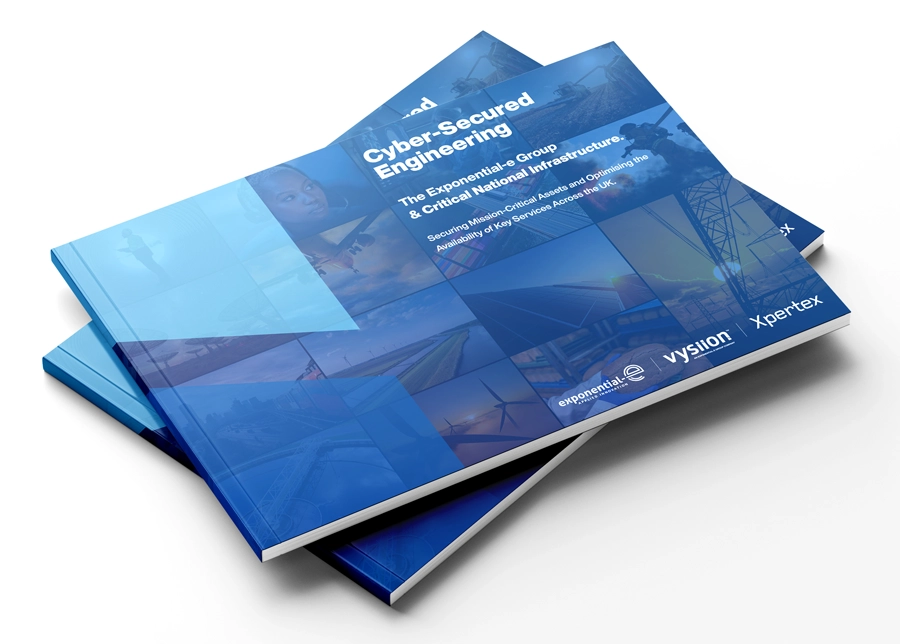
Cyber-Secured Engineering
This brochure sets out the Exponential-e Group's pedigree across the CNI sector, and our full range of capabilities, with real-life case studies of our ongoing work with leaders and innovators across the sector.
61 Hits

© 2026 Exponential-e Ltd. Reg. No. 04499567, Reg. Address:100 Leman Street, London E1 8EU