

Interconnected Fire Services Demand a New Breed of Infrastructure.
The UK’s firefighters make every second count and demand the same of their infrastructure. Connections between stations, control rooms and vehicles must be highly resilient, highly secure and completely seamless.
Control and Dispatch (CAD).
Truly Real-Time Communications.
Evolving Compliance Requirements.
Cyber Security by Design.
World-class networks have always been the foundation of Exponential-e’s solutions, and when it comes to the delivery of critical services across the UK, their importance cannot be overemphasised. This project will help ensure fire and emergency services are always readily available, whenever and wherever they are needed.
A Trusted Connectivity Partner for UK Fire Services.
As a pioneer of UK connectivity and a trusted technology partner to the emergency services for more than twenty years, Exponential-e is actively supporting this journey, working with the Networked Fire Services Partnership and other organisations to ensure critical services are supported by their digital infrastructure.
Our security-cleared specialists help blue light organisations replace end-of-life systems with secure, sovereign and highly scalable platforms designed for mission-critical operations.
Every Second Counts. Every Connection Matters.
Secure, highly available connectivity between the control room, station and frontline enables faster decisions, coordinated dispatch and resilient response.
Solutions That Provide That All-Important Edge in Every Emergency.
Six interconnected capabilities help fire and rescue services maintain availability, secure sensitive information and modernise critical infrastructure.
Connectivity
Cyber Security
Unified Communications
Sovereign Cloud
Data & AI
Managed IT
Our Commitment to Delivering Excellence.
Independent Standards. Embedded Into Every Engagement.
Our independently audited accreditations provide assurance across environmental management, energy efficiency, quality, security, service management, resilience and Cloud security.
ISO 14001
Environmental Management
ISO 14001
Environmental Management

Independent assurance supporting Exponential-e’s standards-driven approach to service delivery.
ISO 9001
Quality Management
ISO 9001
Quality Management

Independent assurance supporting Exponential-e’s standards-driven approach to service delivery.
ISO 22301
Business Continuity Management
ISO 22301
Business Continuity Management

Independent assurance supporting Exponential-e’s standards-driven approach to service delivery.
ISO 50001
Energy Management
ISO 50001
Energy Management

Independent assurance supporting Exponential-e’s standards-driven approach to service delivery.
ISO/IEC 27701
Privacy Information Management System
ISO/IEC 27701
Privacy Information Management System

Independent assurance supporting Exponential-e’s standards-driven approach to service delivery.
ISO/IEC 27001
Information Security Management
ISO/IEC 27001
Information Security Management

Independent assurance supporting Exponential-e’s standards-driven approach to service delivery.
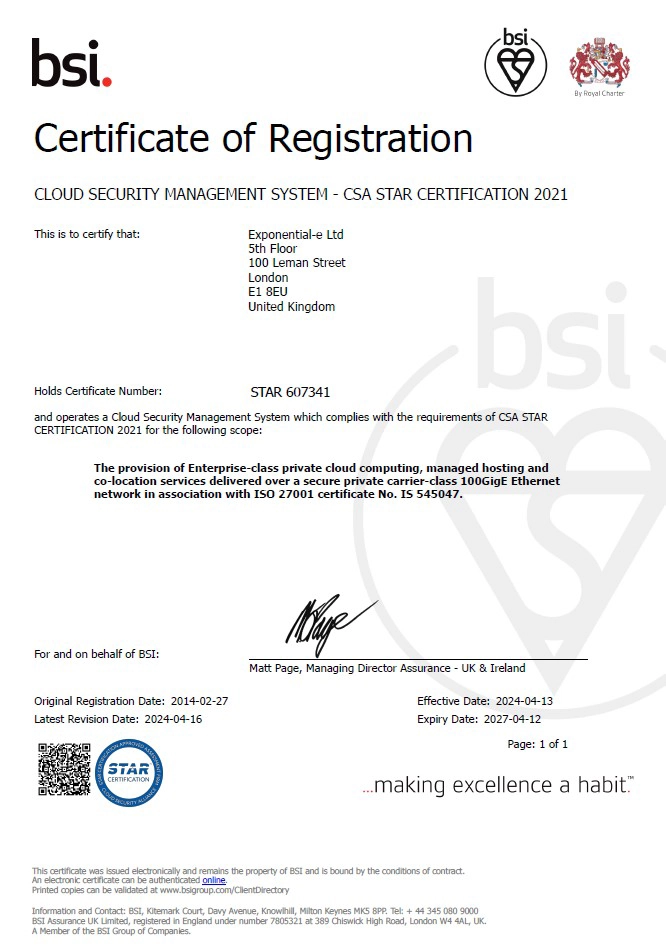
CSA STAR
Cloud Security
CSA STAR
Cloud Security

Independent assurance supporting Exponential-e’s standards-driven approach to service delivery.
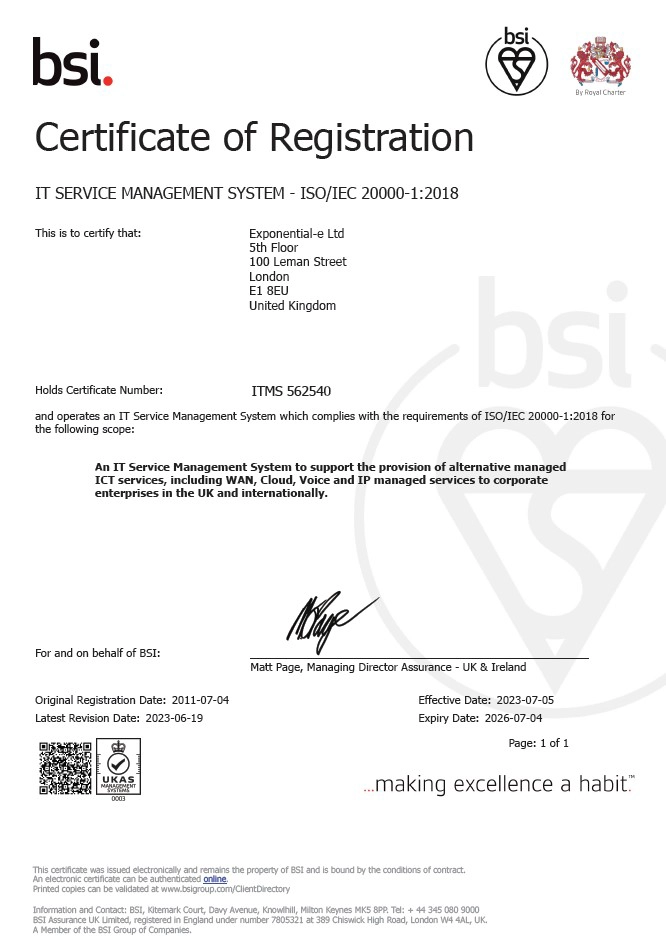
ISO/IEC 20000-1
Service Management
ISO/IEC 20000-1
Service Management

Independent assurance supporting Exponential-e’s standards-driven approach to service delivery.
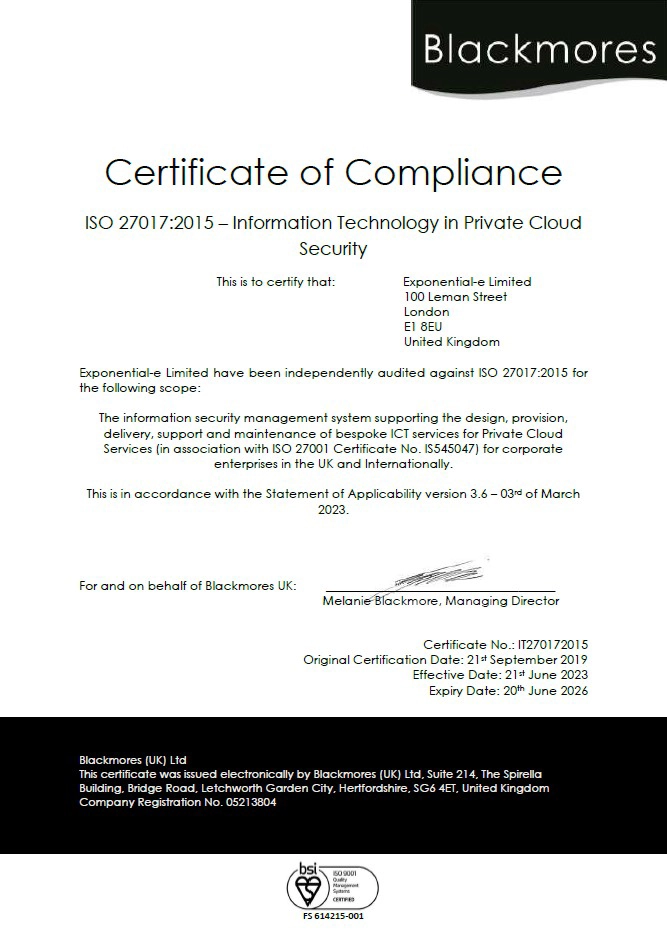
ISO 27017
Security Controls for Cloud Services
ISO 27017
Security Controls for Cloud Services

Independent assurance supporting Exponential-e’s standards-driven approach to service delivery.






Real-World Experience in Mission-Critical Services.
Explore how Exponential-e and Vysiion support emergency services and healthcare organisations with secure connectivity, managed infrastructure and operational resilience.

Networked Fire Services Partnership (NFSP).

Keeping Control and Dispatch Connected.
Highly secure, resilient connectivity linking control rooms, back-up control rooms and data centre environments to support critical Control and Dispatch operations.

Supporting the Next Generation of Blue Light Communications.
Supporting the Home Office's Emergency Services Network User Services Programme and the secure, highly available communications foundations required by frontline responders.
Questions Shaping the Future of UK Fire Services.
Practical guidance on resilience, modernisation, secure communications and technology governance for fire and rescue trusts.
Multiple dimensions of network resilience are essential for all fire and rescue services’ underlying connectivity and unified communications services, including diverse network routes, automatic failover, traffic prioritisation and proactive 24/7 monitoring. For this reason, Exponential-e’s self-owned network remains the foundation of our entire solution portfolio and we continue to develop it in response to evolving requirements around resilience, security, and availability.
With even the shortest periods of downtime having potentially serious consequences, the migration of emergency services’ legacy systems requires a phased migration strategy, incorporating rigorous auditing and testing of existing systems and processes, parallel environments, and documented rollback procedures. For this reason, all of Exponential-e’s engagements with fire and rescue services begin with a period of intensive consultation, establishing a complete picture of legacy systems and how they can be successfully migrated with minimal disruption.
The interconnected nature of modern emergency services means that a holistic approach to connectivity is required, bringing together leading-edge networking, security, and unified communications solutions. SD-WAN, SSE and SASE all have a role to play here, ensuring all security policies are consistently applied on the frontline. The ability to connect to the HSCN is also essential, in order to maximise interoperability and cross-agency collaboration. With this blend of networking and security as the foundation, the performance and resilience of communication across multiple channels can be maximised.
With emergency services representing a prime target for bad actors, a ‘secure by design’ approach to protecting critical data, based on the latest threat intelligence and globally recognised standards is essential. This should incorporate network segmentation, identity and access management, continuous threat monitoring, secure backup and air-gapped disaster recovery and ransomware remediation, in order to ensure critical data and infrastructure can be restored as quickly as possible in the event of a breach, keeping downtime to the absolute minimum. This should all be overseen by a 24/7, UK-based SOC, ensuring auditable reports are created and all incidents identified and responded to immediately.
Effective emergency response times depend on seamless, secure flows of real-time data between control rooms and the frontline and between multiple agencies. How this is achieved will depend largely on the specific trust’s current level of digital maturity, but will typically focus on the consolidation and modernisation of siloed legacy systems, phasing them out in favour of high-performance connectivity, reliable mobilisation platforms, and integrated operational data. When executed successfully, with the support of a trusted technology partner, this will improve system responsiveness, resource visibility and the reliability of time-critical workflows.
Computer-Aided Dispatch (CAD), communications and mobilisation applications demand the highest level of resilience and availability, incorporating high-performance data-centre architectures, geographically diverse connectivity, redundant infrastructure, and continuous monitoring, with no single points of failure. This should be combined with the hands-on support of a trusted technology partner and systems integrator, ensuring emerging compliance and security challenges are met, and the entire security and network ecosystem is proactively monitored at all times, with documented alerting and escalation processes in place.
Consolidating multiple siloed services and support arrangements requires the support of a reputable systems integrator who can not only deliver the required technologies and connections, but also demonstrate a keen awareness of emergency services’ singular requirements around security, compliance, and availability, incorporating this into a coordinated operating model with full control and visibility of all costs. In this way, the partner’s role will naturally transition from that of a pure solution provider to that of a trusted technology partner, ensuring infrastructure continues to evolve to fulfil the desired citizen outcomes.
Fire & Rescue trusts should assess their obligations under UK data protection law, the NHS Data Security and Protection Toolkit and applicable cyber resilience requirements. The CAF can support a structured approach to managing cyber risk. The UK Network and Information Systems Regulations and proposed Cyber Security and Resilience Bill may be relevant depending on an organisation’s role and regulatory scope. The EU’s NIS 2 is not automatically applicable to UK-only fire and rescue trusts.
Controls should extend to third-party suppliers, with regular risk assessments, appropriate assurance and documented incident response processes. Explore our CNI guidance.
Maintaining reliable access to mobile data, dispatch information and communication systems across highly dispersed locations demands both the highest standard of technology deployed in all vehicles, combined with effective field support, whenever and wherever required. For this reason, Exponential-e continues to develop our staff’s capabilities and security clearances, enabling them to deliver the most complex installations in the most remote, highly regulated environments. This has allowed us to successfully deliver end-to-end digital transformation initiatives for organisations like the Networked Fire Services Partnership, in preparation for the launch of the ESN.
A consistent approach to IT incident support across dispersed fire and rescue stations, control rooms and operational facilities will typically begin with the consolidation and standardisation of underlying systems, phasing out legacy, end-of-life systems when necessary. With this resilient, intelligently integrated foundation established, real-time monitoring can be assigned to a trusted technology partner, able to maintain a 24/7, UK-based CSOC, with clearly defined Service Level Agreements (SLAs) and security-cleared field services teams available, when required.
Intelligence for an Evolving Fire & Rescue Landscape.
Explore the latest thinking on Emergency Services Network transformation, resilient connectivity, cyber security, operational continuity, data sharing and the technologies shaping the future of UK emergency response.

Vysiion supports South East Water to strengthen operational resilience
UK-based OT and IT infrastructure specialist Vysiion, an Exponential-e Group company, has been awarded the South East Water Wide Area Network (WAN) Infrastructure and Support Services contract to deliver a modern, secure and resilient communications ...
Read More →
Preparing the UK’s Critical National Infrastructure for the Cyber Security & Resilience Bill
Across the UK's Critical National Infrastructure (CNI), cyber security is now firmly established as a board-level priority, rather than the sole purview of IT and security teams. In response to the increasing range of cyber threats mounted by global ...
Read More →
As the PSTN switch-off approaches, CNI organisations must be ready to futureproof their telephony
The seamless delivery of critical services to the public depends on highly secure, resilient connections - not just the networks that interlink IT and OT systems, but the channels of communication that operations depend on. From ensuring citizen...
Read More →Build a More Resilient Digital Foundation for Fire & Rescue Services.
Discuss ESN readiness, secure connectivity, control-room resilience, cyber security and the practical steps towards an always-on operating model.
Contact Us
Sales: 0808 258 5785
Service & Support: 0800 130 3365
Follow Exponential-e
 Your feedback mattersReview us on Google★★★★★
→
